Why a Single 'Dollars Recovered' Number Isn't the Full Picture
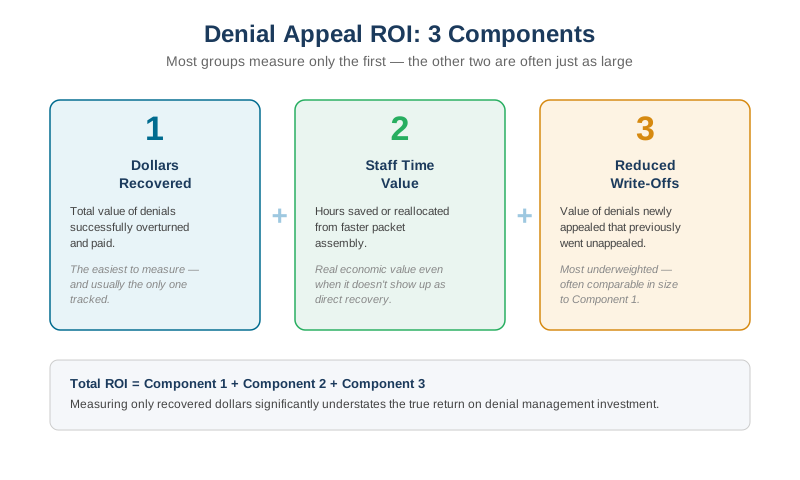
It's tempting to measure denial appeal ROI purely by dollars recovered from successful appeals, but that understates the full value. A complete framework accounts for three components together: dollars recovered from successful appeals, staff hours saved (or better allocated) through more efficient process, and reduction in write-offs from claims that previously went unappealed entirely.
Component 1: Dollars Recovered
The most direct component: total dollar value of denials successfully overturned and paid, over a defined period. This is the easiest to measure and usually the number leadership focuses on first, but it's incomplete on its own.
Component 2: Staff Time Value
Using the staff-hours framework from calculating the true cost of manual drafting, any reduction in time-per-packet translates into either direct cost savings or reallocated capacity — staff time freed up for other high-value work, which has real economic value even when it doesn't show up as a direct dollar recovery.
Component 3: Reduced Write-Offs From Previously Unappealed Denials
This is the component most groups underweight. If a portion of denials previously went unappealed simply due to capacity constraints, and a process change increases the percentage actually appealed, the dollar value of that newly-captured group is a direct ROI contributor — separate from the recovery rate on claims that were already being appealed.
Putting It Together
A complete ROI calculation sums all three components against the cost of whatever investment (staffing, process change, tooling) produced the improvement. Groups that measure only Component 1 tend to significantly understate the true return, since Components 2 and 3 are often comparable in magnitude, particularly for organizations previously appealing only a small fraction of eligible denials.
ResolveRCM's own early data shows the pattern this framework predicts — meaningful staff-hours savings and a high appeal-to-payment rate together. See the full data in our investor materials, or learn how it applies to your volume. |