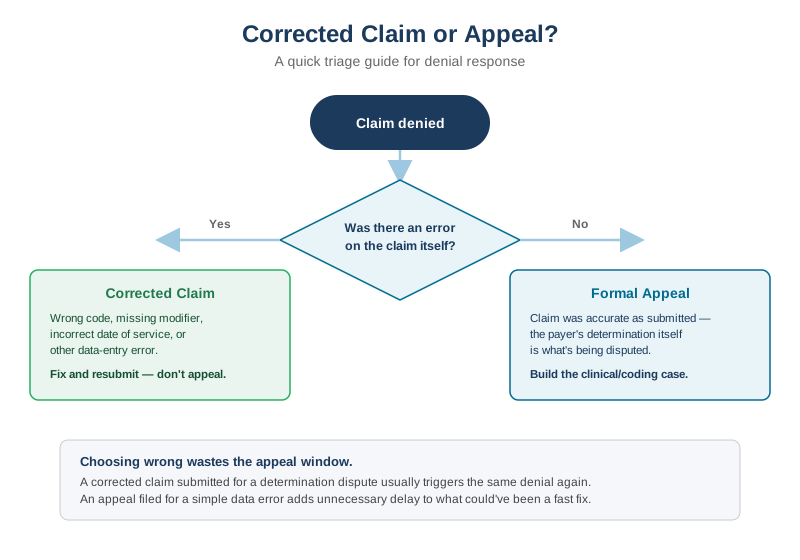
Two Fundamentally Different Responses
A corrected claim is a resubmission fixing an error in the original claim — a wrong code, a missing modifier, an incorrect date of service. An appeal is a request to reconsider a determination the payer made about a claim that was, as submitted, processed correctly by the payer's own account. Confusing the two is a common and costly mistake.
When a Corrected Claim Is the Right Move
If the denial reason points to an error on the claim itself — a typo in a code, a missing required field, an incorrect provider or facility identifier — the fastest and most appropriate fix is usually a corrected claim resubmission, not a formal appeal. Appealing a data-entry error, rather than simply correcting and resubmitting it, adds unnecessary delay.
When an Appeal Is the Right Move
If the claim itself was accurate as submitted and the payer's determination is what's being disputed — a medical necessity finding, a bundling decision, a coverage determination — a corrected claim resubmission won't accomplish anything, since there's nothing factually wrong with the original claim to correct. This requires a formal appeal addressing the payer's actual determination.
The Risk of Choosing Wrong
Submitting a corrected claim when an appeal was actually needed often just triggers the same denial again, since nothing about the underlying determination has changed — and can consume time that was needed for the appeal deadline. Submitting an appeal for what was actually a simple data error adds unnecessary process and delay to what could have been a fast fix. Getting the initial triage decision right saves meaningful time in both directions.
ResolveRCM triages each denial automatically — corrected claim or appeal — before generating the appropriate response. Learn more. |