What CARC Codes Are and Who Maintains Them
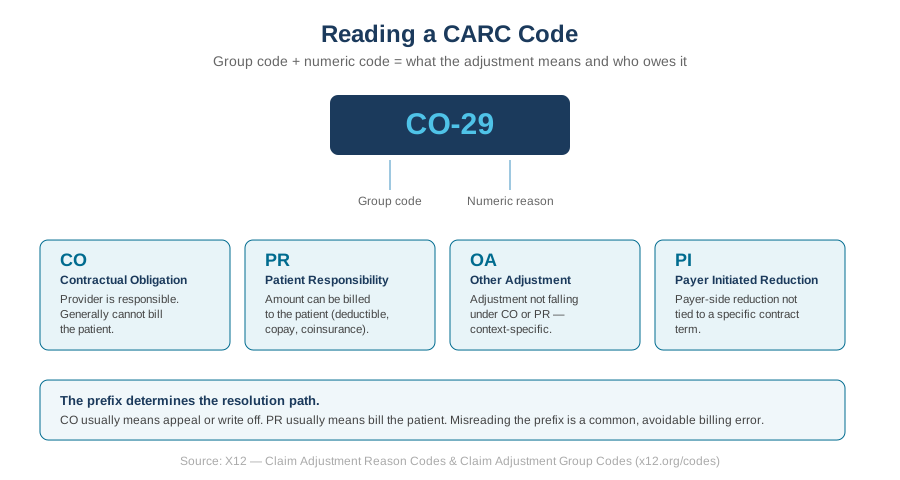
Claim Adjustment Reason Codes (CARCs) are a standardized set of codes maintained by X12, the same organization that maintains the broader EDI standards used in healthcare claims processing. Because they're standardized rather than payer-specific, a CO-29 or CO-50 means the same underlying thing regardless of which payer issued it — though how a specific payer's system applies a given code in practice can still vary somewhat.
Understanding the Group Code Prefix
Every CARC appears with a group code prefix that changes its meaning. CO (Contractual Obligation) means the provider is contractually responsible for the amount and generally cannot bill the patient. PR (Patient Responsibility) means the amount can be billed to the patient. OA (Other Adjustment) and PI (Payer Initiated Reductions) cover other adjustment scenarios. Reading the group code alongside the numeric code is essential — the same numeric code can carry a different implication depending on its prefix.
Why a Reference Library Matters for Routing
The practical value of a CARC reference isn't memorizing every code — it's routing denials to the right response quickly. Codes tied to coordination of benefits, timely filing, authorization, and medical necessity each require a fundamentally different resolution path, and a biller who can quickly identify which category a code falls into moves faster than one starting from scratch on every denial.
Building This Into Team Onboarding
For teams onboarding new billing staff, a structured CARC reference — organized by category (filing, authorization, necessity, coordination, coding/bundling) rather than strictly numerically — tends to build competence faster than expecting new staff to learn code meanings denial by denial over months on the job.
ResolveRCM automatically categorizes incoming denials by CARC code and routes them to the appropriate response — so your team doesn't have to look up every code manually. Learn more. |