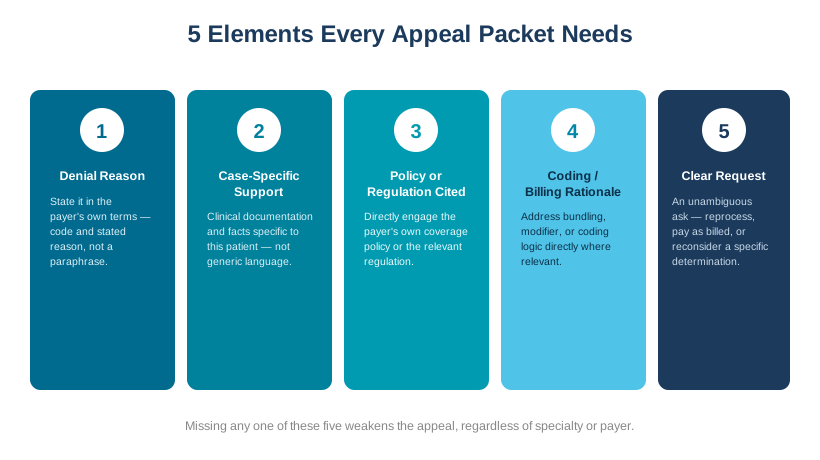
Element 1: A Clear Statement of the Denial Reason
A strong appeal opens by stating exactly what the payer denied and why, in the payer's own terms (referencing the specific denial code and stated reason) — not a paraphrased or assumed version of the reason. This grounds the entire appeal in the actual issue being disputed, rather than a general defense of the claim.
Element 2: Clinical or Factual Support Specific to the Case
This is the evidentiary core of the appeal — the clinical documentation, test results, or factual record that directly addresses the stated denial reason. Generic clinical language that could apply to any similar case is weaker than documentation that's clearly specific to this patient and this service.
Element 3: Reference to the Applicable Payer Policy or Regulation
Appeals that explicitly engage with the payer's own coverage policy, a relevant clinical guideline, or an applicable regulation (parity law, for instance, in behavioral health cases) tend to outperform appeals that make a purely general clinical argument, because they demonstrate the claim meets the specific standard the payer says it's applying.
Element 4: Coding and Billing Rationale Where Relevant
For denials involving coding, bundling, or modifier disputes specifically, the appeal needs to address the coding logic directly — why the codes billed together are separately identifiable, why a modifier applies, or why the level billed is supported — not just the clinical necessity of the underlying service.
Element 5: A Clear, Direct Request
Every appeal should end with an unambiguous statement of what's being requested — reprocessing and payment of the claim as billed, a specific corrected amount, or reconsideration of a specific determination — rather than leaving the reviewer to infer what resolution the provider is seeking.
ResolveRCM structures every generated packet around these five elements automatically, so nothing gets left out under deadline pressure. Learn more. |